QSR Madness – Which Fast Food Chain Has the Best Restaurant Technology?
QSR technology has changed a lot in the last few years. It's time we put the biggest fast food Chain's head to head to see which represents the very best in fast food tech.


Nobody asked for a fast food technology bracket. We made one anyway.
Every March, the NCAA Tournament reminds us that seedings are a suggestion and chalk picks are for cowards. We took that energy and applied it to [[QSR]] restaurant technology — the POS systems, kiosks, and drive-through AI that either make or break your order experience at thousands of locations simultaneously.
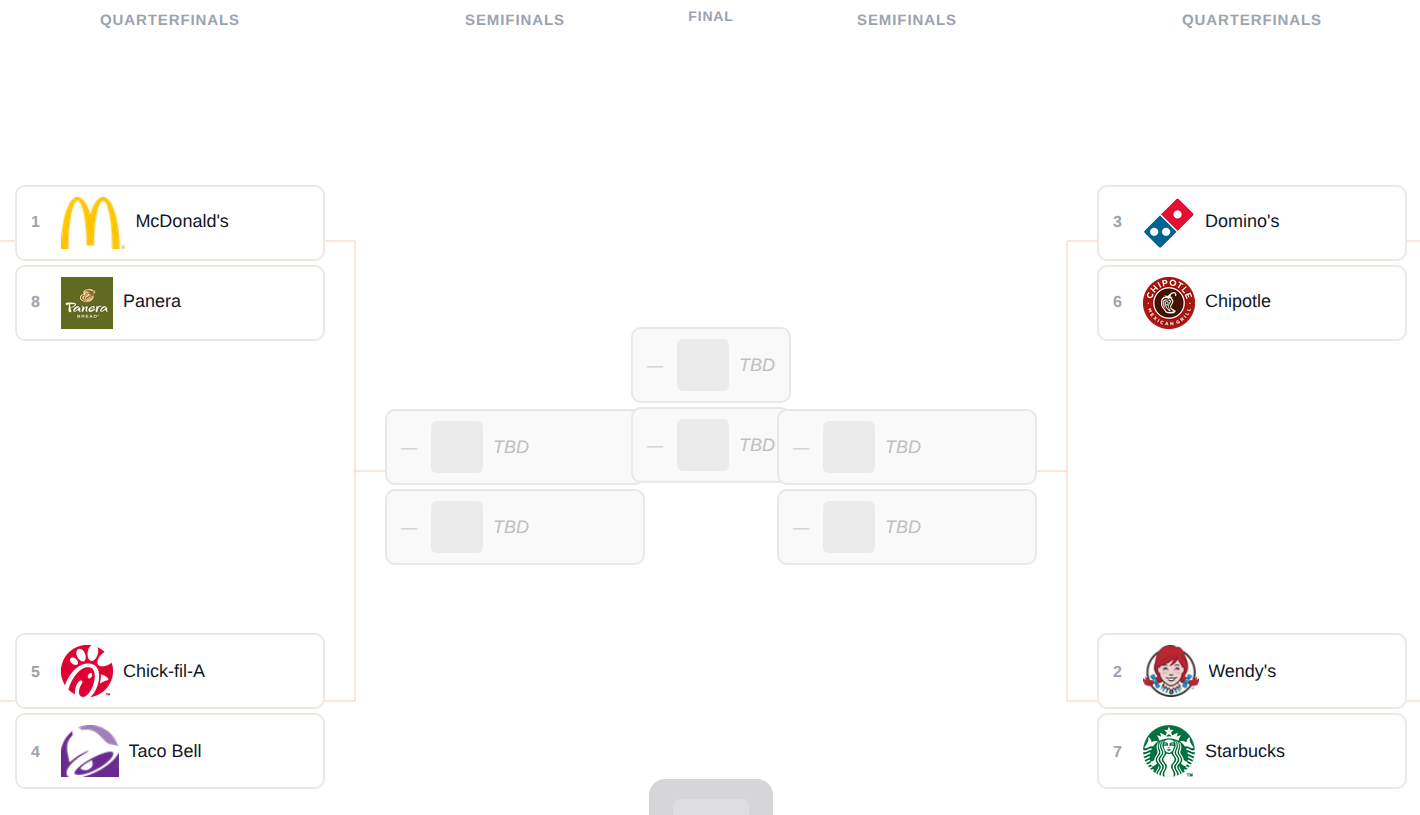
Sixteen chains. Single elimination. One champion. Welcome to QSR Madness.
The rules are simple. Sixteen chains, seeded by a composite of American Customer Satisfaction Index (ACSI) scores, publicly reported tech investments, kiosk and digital ordering penetration, and data from the Canopy 2025 Restaurant Tech Report. The bracket is weighted toward in-restaurant [[peripheral]] reliability — [[POS systems]], [[kiosks]], [[digital menu boards]], [[payment terminals]], and [[kitchen display systems]] — because those are the devices that determine whether your order goes smoothly or falls apart at 12:30 on a Tuesday.
A great app built on top of unreliable hardware is not a competitive advantage. It is a very expensive way to disappoint people.

The Quick Service Restaurants in our 16 Team Bracket
1. McDonald's The clear #1 seed. McDonald's runs on NewPOS NP6, a proprietary POS platform deployed across more than 14,000 U.S. locations, and has rolled out 130,000+ kiosks globally. A 2025 technology overhaul across 43,000 restaurants added AI-powered accuracy scales and internet-connected kitchen equipment. Digital orders now account for more than 40% of sales.
2. Wendy's Wendy's is making the strongest AI argument in QSR with FreshAI, its generative AI drive-through ordering system built on Google Cloud. Launched in 2023, it's now active in hundreds of locations and has demonstrated 22-second faster service times and 80 basis points of margin improvement at company-operated restaurants.
3. Domino's Domino's is the bracket's sleeper pick — a tech company that happens to sell pizza. Their proprietary PULSE POS system has been mandatory across all franchises since 2003, is now on its third major version (Next Gen Pulse, 2023), and underpins everything from pizza tracking to delivery logistics. They're also developing Dom.OS, a proprietary operating system to run beneath it.
4. Taco Bell Taco Bell runs on Poseidon, Yum! Brands' proprietary POS, now consolidated into the broader Byte by Yum platform. Their app and loyalty program are widely considered the best in QSR, and AI-powered Voice AI ordering is active across hundreds of drive-throughs. The tech is impressive — it just lives in an ecosystem shared with KFC and Pizza Hut.
5. Chick-fil-A Chick-fil-A built a custom POS layer on PAR Technology hardware using Ditto's Intelligent Edge Platform — notably designed to operate completely without an internet connection. That offline resilience is a genuine competitive advantage. They've led the ACSI restaurant satisfaction rankings for 11 consecutive years, scoring 83 in 2025.
6. Chipotle Chipotle has made serious kitchen automation bets. Their Chipotlane digital pickup lane infrastructure is well established, and they've invested $25 million in Hyphen's Augmented Makeline — a robotic assembly system now being tested in restaurants. Solid tech ambition, but deployment is still uneven across locations.
7. Starbucks A mobile ordering pioneer that over-indexed on its app and created real throughput problems — mobile orders flooded cafes faster than staff could fill them. The current turnaround strategy involves explicitly pulling back from digital-first operations. The loyalty ecosystem remains one of the most sophisticated in the industry, but in-store operations are still catching up.
8. Panera Bread Panera 2.0 was one of the most ambitious integrated tech platforms in fast casual when it launched in 2014 — combining kiosks, loyalty, rapid pickup, and a centralized data backbone called the Panera Data Pantry. A March 2024 ransomware attack took the entire stack offline for nearly a week, exposing how much risk had been concentrated in a single integrated system.
9. Shake Shack Shake Shack has made steady digital investments — strong app, solid mobile ordering, and a clean kiosk experience in many locations. Their tech stack is capable but not differentiated, and in-restaurant peripheral reliability across their growing footprint remains a work in progress.
10. Dunkin' Dunkin' runs a capable loyalty and mobile ordering program with a large active user base. Their DD Perks app drives meaningful digital sales, and they've made consistent kiosk investments. Not flashy, but functional — which in QSR tech is more of a compliment than it sounds.
11. Jack in the Box Jack in the Box has invested in digital menu boards and drive-through technology, but their tech stack is heavily dependent on third-party vendors without a strong proprietary system anchoring it. Franchise-level consistency is a known challenge.
12. Wingstop Wingstop is genuinely digital-forward — the vast majority of their orders are placed digitally, and they've been rolling out their Smart Kitchen platform to improve operational efficiency. Their in-restaurant peripheral footprint is thin by design, which works until something goes wrong.
13. KFC KFC shares Yum! Brands' Byte by Yum platform with Taco Bell and Pizza Hut, giving them access to solid underlying infrastructure. But consistency across KFC's large franchise base — particularly internationally — remains a challenge. Their AI restaurant coach pilot is interesting but early.
14. Popeyes Under Restaurant Brands International ownership alongside Burger King and Tim Hortons, Popeyes has no confirmed proprietary tech stack. RBI has struggled to deploy consistent technology across its franchise networks, and Popeyes bears the consequences at the store level.
15. Burger King Also under RBI, Burger King has announced numerous tech initiatives over the years — digital menu boards, app investments, kiosk rollouts — but execution across its large franchise base has been inconsistent. No confirmed proprietary POS system, which makes systemwide standardization difficult.
16. Sonic Sonic's 2025 ACSI score dropped to 75, reflecting a digital experience that lags the rest of the bracket. Their drive-in model creates real structural challenges for tech deployment — there's no confirmed proprietary POS system, and app and ordering terminal reliability have been consistent customer complaints. A first-round exit.
Round of 16: The Restaurant Tech Field Thins
Most first-round matchups went according to seed. A few are worth examining.
(1) McDonald's vs. (16) Sonic
The most lopsided matchup in the bracket. McDonald's runs on NewPOS NP6 — also catalogued as the [[McDonald's NP6 System]] — a proprietary [[POS]] platform acquired in 2007 and continuously upgraded since. In 2025, McDonald's rolled out a major technology overhaul across 43,000 restaurants, integrating internet-connected kitchen equipment with AI-driven systems and deploying AI-powered accuracy scales that weigh every order at drive-throughs, [[kiosks]], and delivery stations to verify contents. Kiosks now cover more than 14,000 U.S. locations, with digital orders representing over 40% of sales.
Sonic has no confirmed proprietary system to point to. Their 2025 ACSI score fell 4% to 75, reflecting aging drive-in infrastructure and a digital experience that trails most of the bracket.
Sonic has a first-round exit.
(5) Chick-fil-A vs. (12) Wingstop
Chick-fil-A runs PAR Technology hardware with a custom software layer built on Ditto's Intelligent Edge Platform, which enables the [[POS]] to operate completely independent of an internet connection. That offline resilience is a meaningful advantage in a bracket weighted toward [[uptime]]. Chick-fil-A also leads the entire restaurant industry in ACSI satisfaction, scoring 83 for the 11th consecutive year.
Wingstop is digital-forward with a high online ordering mix. They’re also making strides with their Wingstop Smart Kitchen rollout, but their in-restaurant [[peripheral]] footprint is thin.
In this chicken vs. chicken matchup, Chick-fil-A advances comfortably.
(3) Domino's vs. (14) Popeyes
Domino's runs on PULSE, a fully proprietary [[POS]] and in-restaurant management platform that has been required of all franchisees since 2003. PULSE is now on its third major version, Next Gen Pulse (2023), and Domino's is developing a proprietary operating system called Dom.OS to sit beneath it. The consistency that comes from a mandated, owned stack is one of the main reasons Domino's makes a deep run in this bracket.
Popeyes, under Restaurant Brands International (RBI) ownership, has no confirmed proprietary system and has struggled with consistent tech deployment across its franchise base.
Domino's advances easily.
(2) Wendy's vs. (15) Burger King
Wendy's is deploying [[Wendy's FreshAI]], a generative AI drive-through ordering system built on Google Cloud. Launched in 2023 with a single Columbus, Ohio test location, FreshAI is now active in more than 100 locations, with a target of 500 to 600 locations by end of 2025. The initial Columbus test showed service times 22 seconds faster than the regional average.
Burger King has no confirmed proprietary system name. Both chains operate under franchise-heavy models with historically inconsistent tech rollouts, but Wendy's FreshAI momentum pushes them through.

Other First-Round Results
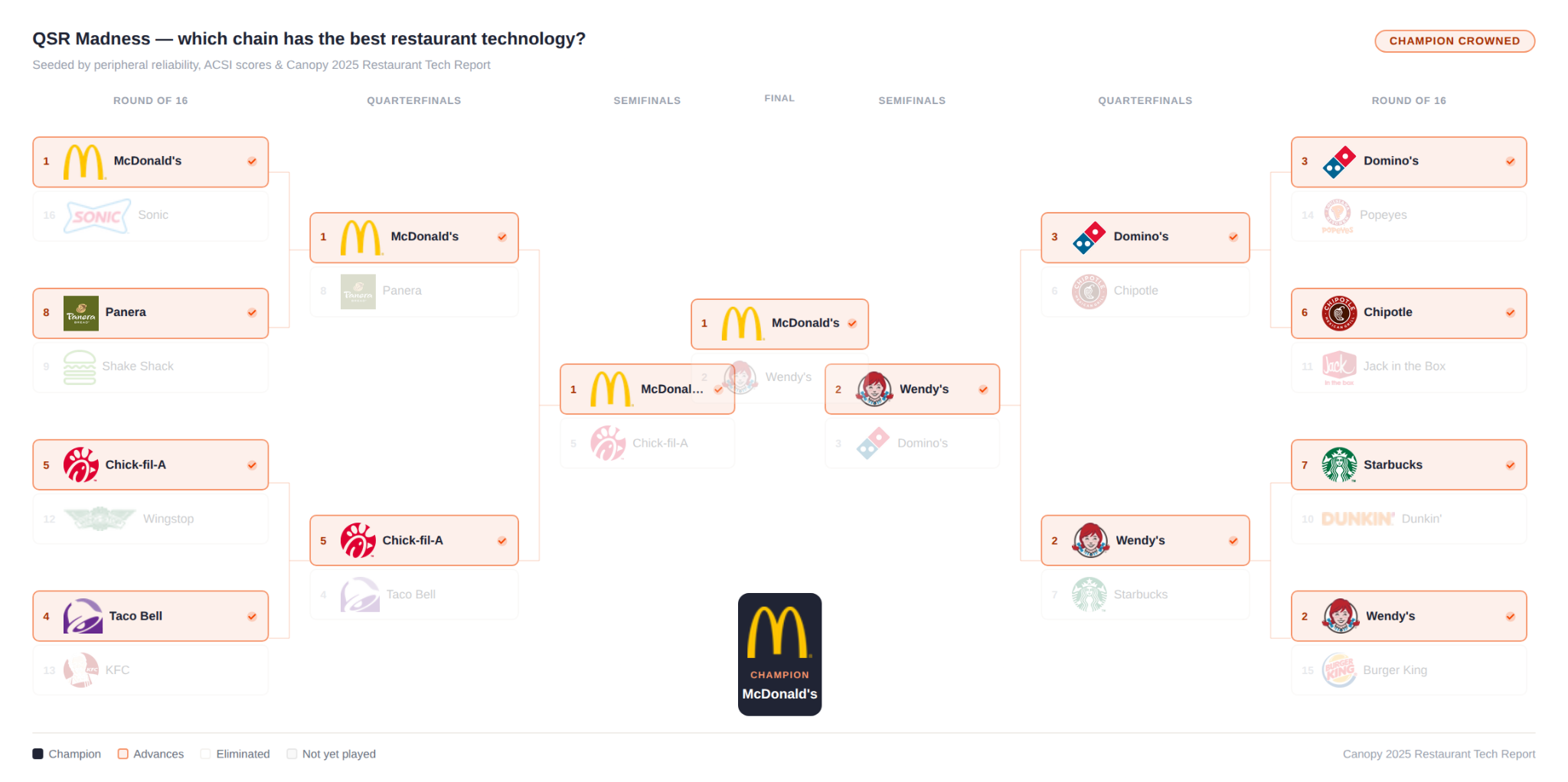
Taco Bell (4) over KFC (13), Chipotle (6) over Jack in the Box (11), Starbucks (7) over Dunkin' (10), Panera (8) over Shake Shack (9). All advance as seeded.
Get Fast Food Fault Lines
Access the 2026 Restaurant Tech Report instantly, and find out how to run a more reliable restaurant.
Get Fast Food Fault Lines
Access the 2026 Restaurant Tech Report instantly, and find out how to run a more reliable restaurant.
Quarterfinals: Styles Start to Clash
(1) McDonald's vs. (8) Panera Bread
Panera's [[Panera 2.0 platform]], launched in 2014, was genuinely ahead of its time. It combined Fast Lane iPad [[kiosks]], MyPanera loyalty integration, a rapid pickup system, and a centralized data backbone called the Panera Data Pantry built with TIBCO. At launch, it represented one of the most sophisticated integrated tech stacks in fast casual.
But in March 2024, a ransomware attack took down Panera's entire digital infrastructure for nearly a week, knocking out online ordering, in-store [[kiosks]], [[POS systems]], and even employee scheduling. The incident exposed how much risk Panera had concentrated into a single tightly integrated stack with insufficient resilience at the edge. A great platform is not much use when it is offline for days at a time.
McDonald's NewPOS NP6, with its breadth of peripheral coverage and operational consistency across 14,000+ U.S. locations, advances.
(5) Chick-fil-A vs. (4) Taco Bell
The most interesting quarterfinal matchup. Taco Bell runs on Poseidon, Yum! Brands' proprietary POS, now folded into the broader Byte by Yum platform alongside AI-powered Voice AI drive-through technology, which is now active across hundreds of U.S. locations. Taco Bell's app and loyalty program are widely considered among the best in QSR, with deep mobile ordering engagement.
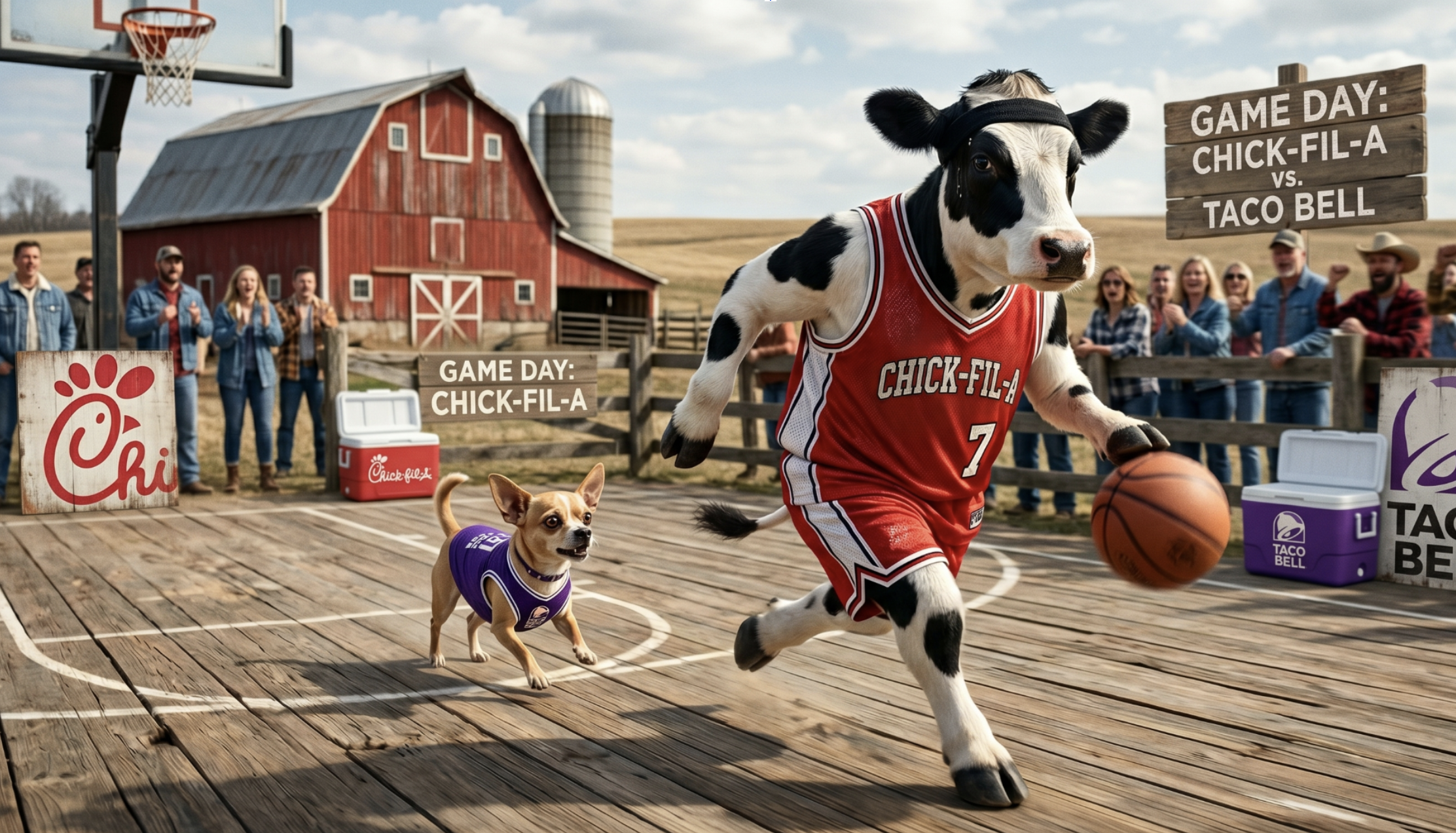
Chick-fil-A wins on in-restaurant execution. The Ditto-powered offline capability means that when the internet goes down, the line keeps moving. PAR hardware reliability and high-touch service supported by tablet-based staff ordering add up to a [[peripheral]] stack that is extremely difficult to match at the store level. The lesson this matchup teaches: app excellence and in-restaurant operational reliability are different muscles. Chick-fil-A advances.
(3) Domino's vs. (6) Chipotle
Chipotle has made real investments. The Chipotlane digital pickup lane infrastructure has expanded meaningfully, and their Augmented Makeline, a robotic assembly system built in collaboration with Hyphen, is now being tested in restaurant locations as of late 2024. As of early 2025, Chipotle has invested $25 million in Hyphen through its Cultivate Next venture fund.
But Domino's wins on consistency. PULSE has been mandatory across the franchise system for over 20 years. Every Domino's location runs the same stack, which means updates deploy uniformly, data is standardized, and there are no franchise-to-franchise surprises. Domino's advances.
(2) Wendy's vs. (7) Starbucks
Starbucks pioneered mobile ordering in QSR and built one of the industry's most sophisticated loyalty programs. But the chain over-indexed on its app in a way that created genuine throughput problems: mobile orders flooded cafes faster than staff could fulfill them, generating a wave of customer frustration. The current Starbucks turnaround involves explicitly pulling back from its digital-first approach to restore in-store operations.
Starbucks has no confirmed proprietary POS name. Wendy's FreshAI has produced real, measurable results. Wendy's advances.
Semifinals: The Final Four

(1) McDonald's vs. (5) Chick-fil-A
This is the matchup the bracket was built for. Two completely different philosophies of QSR technology, both executed well.
McDonald's case: NewPOS NP6 at enterprise scale, 130,000+ [[kiosks]] across more than 14,000 U.S. locations, AI accuracy scales deployed chainwide, and a 2025 overhaul integrating internet-connected kitchen equipment across 43,000 global restaurants. Digital orders account for more than 40% of total sales. The breadth and consistency of McDonald's [[peripheral]] footprint has no equal in the bracket.
Chick-fil-A's case: a cloud-optional, offline-capable POS stack built on Ditto and PAR hardware, tablet-based staff ordering that keeps lines moving, and an ACSI score of 83, the highest in the restaurant industry for 11 consecutive years.
McDonald's advances on raw scale and tech depth. But it is worth noting that Chick-fil-A's offline-capable model may be the smarter architecture for franchisees who cannot afford the throughput loss that comes with a connectivity failure. In a bracket weighted toward [[peripheral]] reliability, it is a closer call than the seeds suggest.
(3) Domino's vs. (2) Wendy's
PULSE is one of the most impressive proprietary tech ecosystems in QSR. Geo-tracking, multi-channel ordering, real-time order status, delivery logistics, loyalty integration all running on a single owned stack. Domino's has spent decades becoming, in their own framing, a tech company that sells pizza.
The bracket exposes a gap, though. PULSE's excellence is concentrated in delivery and ordering infrastructure. Domino's in-restaurant [[peripheral]] stack, the [[kiosks]], [[kitchen display system]] reliability, and [[payment terminal]] coverage that matter for dine-in or carry-out operations, is less developed than a full-service QSR competitor. Wendy's, with FreshAI generating measurable margin improvement of 80 basis points, at company-operated restaurants, presents a more complete in-restaurant picture. Wendy's advances.
The Final: McDonald's vs. Wendy's

Wendy's makes this interesting. FreshAI is the most tangible AI-in-restaurant success story in the bracket, with documented throughput gains, margin improvement, and a clear expansion roadmap. By end of 2025, Wendy's expects FreshAI active in 500 to 600 locations. That is real.
McDonald's wins because they are the only chain that checks every box. NewPOS NP6 runs at scale across tens of thousands of locations globally. [[Kiosks]] cover the domestic footprint with 130,000+ units deployed. AI-powered accuracy scales operate chainwide. Kitchen automation is in active rollout. Digital sales are above 40% of total revenue. The Canopy 2025 Restaurant Tech Report backs up the reliability advantage.
McDonald's is the champion.
.png)
What the Bracket Tells Us
Look at the teams that exit early and a pattern emerges. Sonic lacks a proprietary system and has the customer satisfaction scores to prove it. Burger King and Starbucks have invested heavily in customer-facing technology without building the operational layer underneath consistently. Panera built an impressive integrated stack and then demonstrated what happens when edge resilience is an afterthought.
The teams that go deep share something: they own their core technology. McDonald's owns NewPOS NP6. Domino's requires PULSE across every franchise. Chick-fil-A built a custom [[POS]] layer on Ditto. Taco Bell runs on Poseidon, developed by Yum! Brands internally. Proprietary stacks allow for consistent deployment, standardized data, and the kind of edge-level reliability that third-party platforms often cannot guarantee.
The other through-line is that [[peripheral]] reliability is not a back-office concern. It is a customer experience variable. A [[kiosk]] that is offline at noon on a Tuesday, a [[payment terminal]] that errors at the drive-through, a [[kitchen display system]] that drops tickets during a rush, these are not IT problems. They are revenue problems, and they happen at hundreds or thousands of locations simultaneously if the stack underneath them is not managed properly.
That is the problem that Canopy was built to solve. [[Remote device management]] of the peripheral layer means operators see failures before customers do, push fixes without rolling a [[truck]], and get the data they need to prevent the same issue from recurring across the rest of the [[fleet]].
The real championship is not won in March. It is won every day a [[kiosk]] stays online, a [[payment terminal]] processes without error, and a [[kitchen display system]] fires correctly at 12:30 on a Tuesday.
Learn More
For the data behind this bracket, including device [[uptime]], [[peripheral]] failure rates, and tech satisfaction scores across major QSR chains, see the Canopy 2025 Restaurant Tech Report.
To see how Canopy helps multi-location operators monitor and manage their [[peripheral]] layer, visit gocanopy.com.