Walmart's Electronic Shelf Labels Put Retail Tech Reliability on Display
Electronic shelf labels offer faster pricing and fewer errors. |How Walmart supports e-label reliability with network health, data accuracy, and operational discipline.


Walmart’s Electronic Shelf Labels Put Retail Tech Reliability on Display
At big-box retail stores like Walmart, behind every paper price label is a tedious, time-consuming process. When prices change, employees have to print new labels, walk the floor, and manually replace the tags one by one. The average Walmart carries upwards of 120,000 unique items (a.k.a. “Stock Keeping Units” or “SKUs”), so when pricing updates are required, the process can take hours or even days to complete.
That’s why the chain is rolling out electronic shelf labels or “ESLs” (Walmart calls ESLs “digital shelf labels” or “DSLs”). In 2,300 Walmart locations so far, small electronic displays have taken the place of the old-school paper tags. Whether you call them electronic or digital shelf labels, the retail technology promises a more efficient store, where prices are updated instantly, LED signals speed up restocking and mobile order fulfillment, and employees get more time to help customers.
They also introduce a new layer of technological complexity. ESLs are another node in a delicate network of connected systems. Like everything else in retail tech, ESL technology will be judged on whether it works consistently, and in order to build customer trust, they have a high bar to clear.
Why Walmart is Switching to Electronic Shelf Labels
Updating thousands of price tags by hand is slow, labor-intensive, and error-prone. In comparison, when retailers switch to ESLs, they can push updates to displays from a central pricing system near instantly. This saves labor costs and time: One Walmart employee told CNBC that electronic shelf labels have cut her pricing time by 75%. The speed also helps a retailer adapt fast to pricing changes, which can be especially important amidst supply chain volatility while making it easy to roll out promotions.
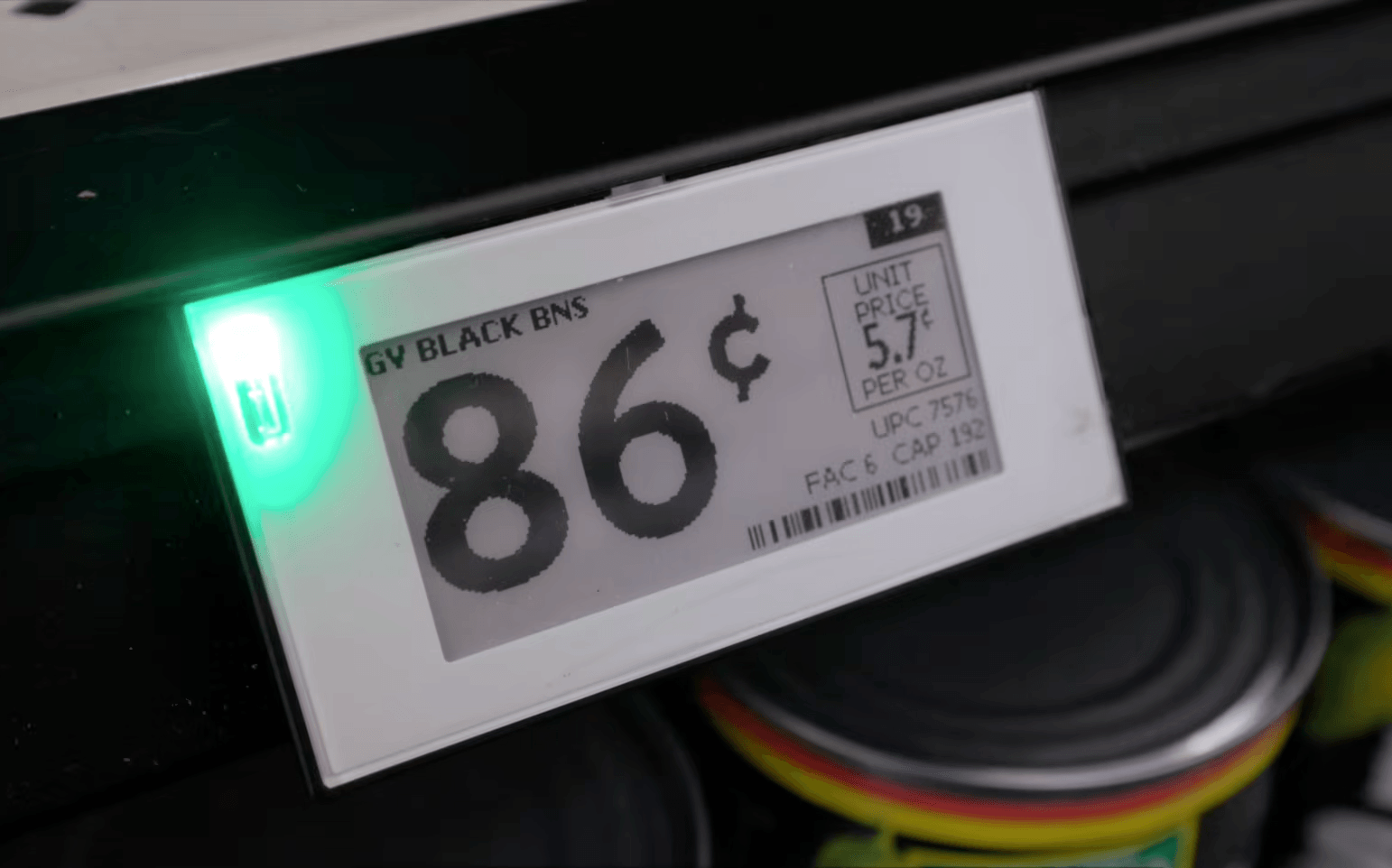
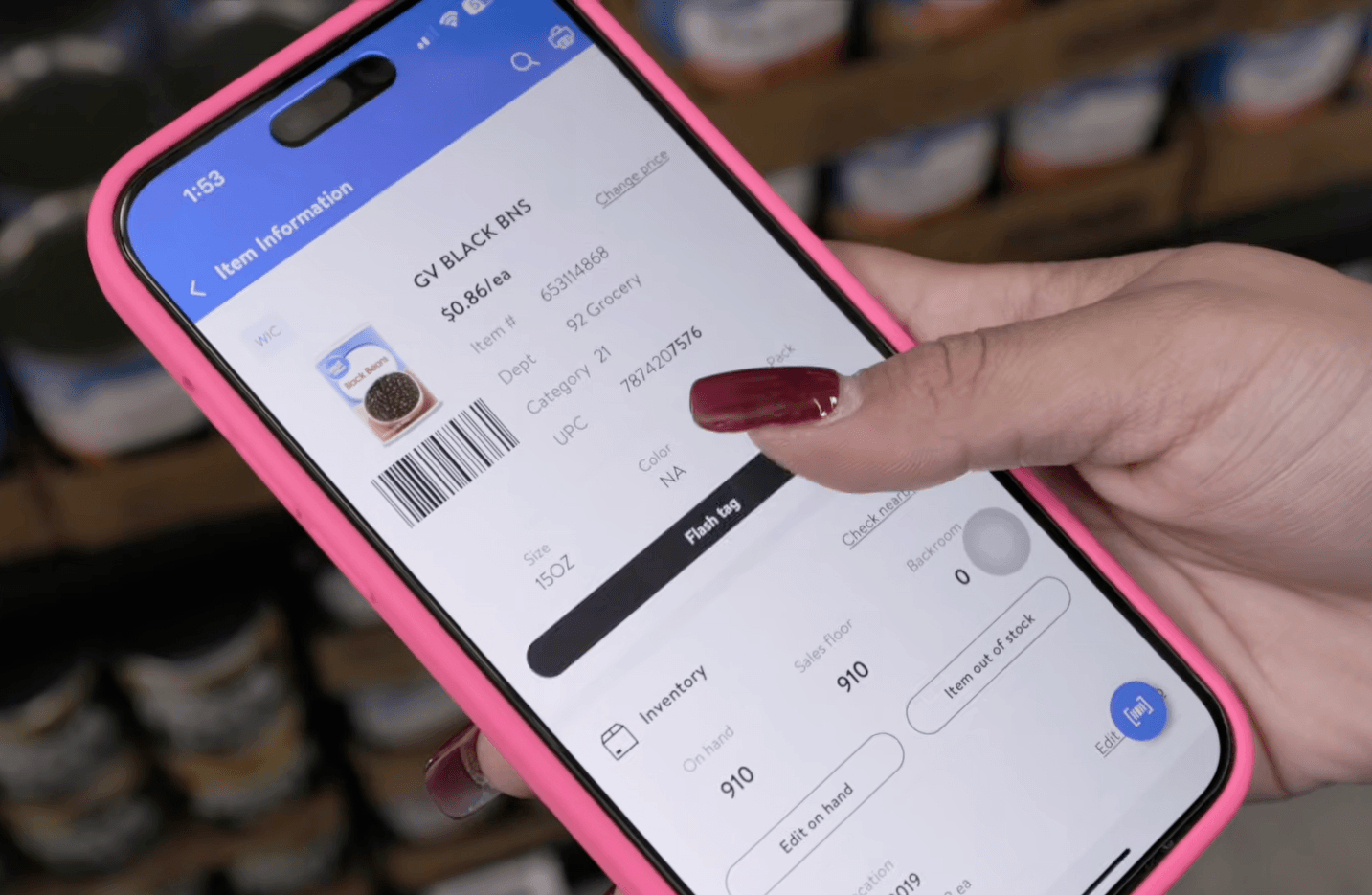
For Walmart, and since they call them digital shelf labels we’ll switch to their preference here on out, DSLs are one aspect of their modern, networked store, where digital tools support pricing and inventory tasks so associates can spend more time on higher value tasks like customer service or order fulfillment. Using handheld devices, employees can trigger LED indicators on individual labels to guide them through online orders or restocking shelves. For example, a Walmart associate can use a handheld mobile device to “flash” a product’s electronic label to make it easier to spot.
Flashing lights indicate the items in an order or that need to be restocked, making it easier for employees to find them, as seen in the photograph above.
In addition to speeding up operations, Walmart hopes DSLs will build customer trust. In theory, using the same system to manage pricing on the shelf and at the register means fewer discrepancies when customers check out.
How Walmart DSLs Work
DSLs are a customer-facing component of a complex, interconnected system of retail technologies. At a high level, here’s what’s happening behind the shelf:
- Central pricing system: All price changes originate here. This system manages product data and pricing, then packages updates to be sent to stores.
- In-store infrastructure: Updates are routed through edge servers or gateways inside each store. These systems manage communication with the label network and coordinate thousands of devices at once.
- Wireless communication layer: Labels connect over low-power radio networks such as Bluetooth Low Energy or other RF protocols. These networks are designed to support high device density while minimizing battery usage.
- Label devices on the shelf: Each label is a battery-powered IoT device with an e-ink display, a wireless radio, and a unique ID. That ID ties the label to a specific product and shelf location.
- Display behavior: E-ink screens show the price and update when prompted, using battery life only when the display changes. Vusion, the vendor behind Walmart’s DSLs, says batteries last up to 13 years, but varied updates mean varied lifespans for each label.
This system operates at a massive scale. A single store can carry tens of thousands of SKUs, each mapped to its own label. Across a national footprint, retailers are managing millions of individual devices. Each store’s network may be coordinating thousands of endpoints simultaneously, all dependent on reliable connectivity, accurate data, and functioning hardware.
At that scale, small issues become more complicated to detect and contain. Some potential problems that could arise:
- If inaccurate data enters the central system, it can propagate across the store.
- If an edge server fails or a network segment drops, labels may fall out of sync.
- If a battery dies, the label may show an outdated price.
- If the mapping between a product and its label is wrong, the price may be accurate in the system but inaccurate at the shelf.
Without manual employee inspection of each label or other means of monitoring, issues can go unnoticed.
Are Electronic Shelf Labels Bad for Employees or Customers?
Not everyone is pleased with DSLs. The United Food and Commercial Workers International Union, an employee advocacy group, has suggested that DSLs make it easier for retailers to adopt predatory pricing. “With this technology, retailers will be able to hike prices in the shopping rush before a snowstorm or after school lets out,” UFCW’s Ademola Oyefeso told Retail Tech Innovation Hub. “The concept of a fair price no longer exists with electronic shelf labels.”
Last year, Instacart faced criticism for a pricing-related program. Its algorithmic pricing scheme used customer data to charge different users different prices for the same products. Instacart described the program as limited and the price differences as "negligible." Consumer Reports disagreed. An investigation found the program was more widespread than Instacart claimed, with price variation ranging from a few cents to several dollars per item.
Less than two weeks after the report came out, Instacart terminated the algorithmic pricing strategy. “Now, if two families are shopping for the same items, at the same time, from the same store location on Instacart, they see the same prices — period,” the company wrote on its website.
Walmart appears to have learned from that episode. The company assures customers that pricing will remain “people-led,” that updates will happen outside store hours to avoid mid-shopping surprises, and that no shopper will pay more than the next.
“It’s important to remember that prices are the same for all customers in any given store and are consistent regardless of demand, time of day, or who is shopping,” Walmart said in a March announcement. “DSLs simply modernize how prices are displayed at the shelf.”
Whether customers trust that commitment is unclear. One shopper claims the price on a DSL climbed right in front of them: “I was at Walmart yesterday and walked up to a grocery item. I watched it change from a sale price to full price within 10 seconds of me being there,” the customer wrote.

Tech issues are already endemic to connected retail systems, for example with [[self-service kiosks]]. How retailers will maintain the promise of consistent updates is yet to be seen.
How Electronic Shelf Labels Break
DSLs face the same potential for issues as other digital retail tools, such as mobile ordering systems and inventory platforms. When tools fall out of sync, inaccurate pricing and inventory can leave customers frustrated.
A few key issues to pay attention to:
- Connectivity. Stores vary in their structure and layout. Interference, network congestion, and hardware limitations can all affect how reliably updates reach each label.
- Data accuracy. If the underlying product catalog is wrong, or if item-to-shelf mappings are not maintained, DSLs will faithfully display incorrect information. As with the inventory inaccuracies that let shoppers place online orders for out-of-stock items, the customer experience falls apart when data is out of sync.
- Timing. Walmart plans to push updates after hours only to avoid confusing customers (or making them suspicious). If a mistake slips through, correcting it while people are shopping could create the very inconsistency the system is designed to prevent, making customers suspect they’re being subjected to Instacart-style flex pricing.
- Battery health. DSLs rely on low-power displays, but they still require close oversight. A label with a dying battery can stop receiving updates without any obvious warning to staff.
Other connected retail systems already struggle with problems like these, each failure chips away at customer confidence. DSLs could bring those same risks into the aisle.
How well DSLs perform long-term remains to be seen. Employees have flagged early issues with battery life. On Reddit, one Walmart employee posted a video of a grocery aisle where hundreds of DSLs flashed red at once.
As explained by another employee, the flashing meant the batteries needed to be replaced. The labels had been in place for less than a year: “Yeah pretty sure they are supposed to last at least 5 years so those are probably all defective,” an employee commented.

Keeping Electronic Shelf Labels (or DSLs) Reliable
DSLs are an upgrade to static labels; however, they require the same operational discipline as any other critical system. The technology requires oversight and management.
Start with network health. Stable store-wide connectivity is the foundation. A store must account for dead zones, interference, and bandwidth constraints. Retail tech operators also need visibility into which labels are online and which are not.
Monitoring and alerting come next. Operators need to know when updates fail, when labels go offline, and when data mismatches occur. Waiting for customers or store associates to report problems can get expensive. A proactive approach eliminates problems before they happen.
Label-to-product mapping requires regular validation. Merchandising plans change, and products move. Without routine audits, pricing and stock mismatches can accumulate. DSLs should reduce labor requirements. Still, employees can conduct manual checks to ensure accuracy.
Battery management too benefits from being proactive. Tracking battery levels across the DSL life cycle can ensure units are replaced before they fail.
Pricing workflows need safeguards too. Validation has to happen before updates are pushed, and rollback mechanisms must be in place in case something goes wrong. They are the difference between a system customers can rely on and one that quietly erodes their trust.

Do you live on the edge of endpoint management?
Discover how global brands and businesses manage their connected product ecosystems. Get the inside-scoop from the hidden architects and teams who ensure their remote devices never go down.
Subscribe to the Canopy Insights newsletter.
Do you live on the edge of endpoint management?
Discover how global brands and businesses manage their connected product ecosystems. Get the inside-scoop from the hidden architects and teams who ensure their remote devices never go down.
Subscribe to the Canopy Insights newsletter.
Supporting Technology Reliability Builds Trust
Whether or not customers trust DSLs depends on how well they work. The price on the shelf should match what they pay every time.
When a shopper sees one price in the aisle and another at checkout, they may get confused and start asking hard-to-answer questions. When did the price actually change? Can I trust what I'm seeing? An associate can explain that the label didn't update in time, but that explanation arrives too late. Once that doubt takes hold, it's hard to undo.
Scale that across thousands of stores and millions of transactions, and a few small inconsistencies become a pattern. Customers notice. They talk.
The alternative is straightforward. Prices match every time. Updates happen without disruption. Associates trust the system, and customers stop thinking about pricing tech altogether because it simply works.
DSLs have a spotlight on them. Customers, employees, and regulators are all watching how this technology behaves in practice. The only way to earn the trust DSLs need is through consistency at the shelf, at checkout, and across every store.