10 Years of Growth: How Nathan Rowe Helped Shape Canopy from Professional Services to Product-First
Nathan Rowe marks 10 years at Canopy, reflecting on his evolution from Tier 3 support to VP of Customer Success and Product through company growth and transformation.


Nathan Rowe is the Vice President of Customer Success and Product at Canopy. Nathan recently reached an incredible milestone, achieving ten years of work with Canopy.
Over the past decade, Nathan has served as an integral part of our team whether in the early days as part of Banyan Hills Technology and the recent years building Canopy into what it is today. His dedication and years of experience add a richness and expertise to everything Nathan does.
To mark the occasion, we asked Nathan to share with us a few reflections from his last ten years. You might be surprised about what you learn below, even if you know Nathan. If you have yet to work directly with Nathan, you’ve experienced the results of his work — through using Canopy.
What brought you to Canopy initially?
I worked with Steve Latham and Webb Morris at NCR in the entertainment line of the business, supporting Blockbuster Express, and that was where I started my career in corporate technology, software, and kiosk support. When Redbox purchased that line of business, I helped shut down the company as Redbox came in and took over the kiosks and the relationships. It got to a point where I needed to find another opportunity, and I had a couple of options.
I had a conversation with Steve, and we talked about where I should go next in NCR and the opportunities. There was an opportunity for me to work with him at NCR Silver, and another to go and support ATMs on the financial services side of the business. I chose to go to the ATM support team and ended up supporting ATMs globally. But when I had that conversation with Steve, he said, "Well, you know, if you go to ATM support, that's good, that'll be good for you. But at some point I'm gonna give you a call, and when I give you a call, you just have to answer."
I remembered that conversation, and about three years later, Steve reached out and said, "Hey, you know, let's have a conversation."
At that point, Banyan Hills Technologies was just entering a phase where they needed someone to come in and run a kind of Tier 3, Level 3 support team and start building out the IT side of the business and things like that. So it was a logical time for me to join the company, and I'm glad that I took that call.
(Banyan Hills Technologies is the original company that is now known as Canopy, a change in name that officially happened in August 2023. For the sake of this interview, Banyan Hills and Canopy will be used interchangeably.)
How has your role changed over the past 10 years, and what has surprised you most about that journey?
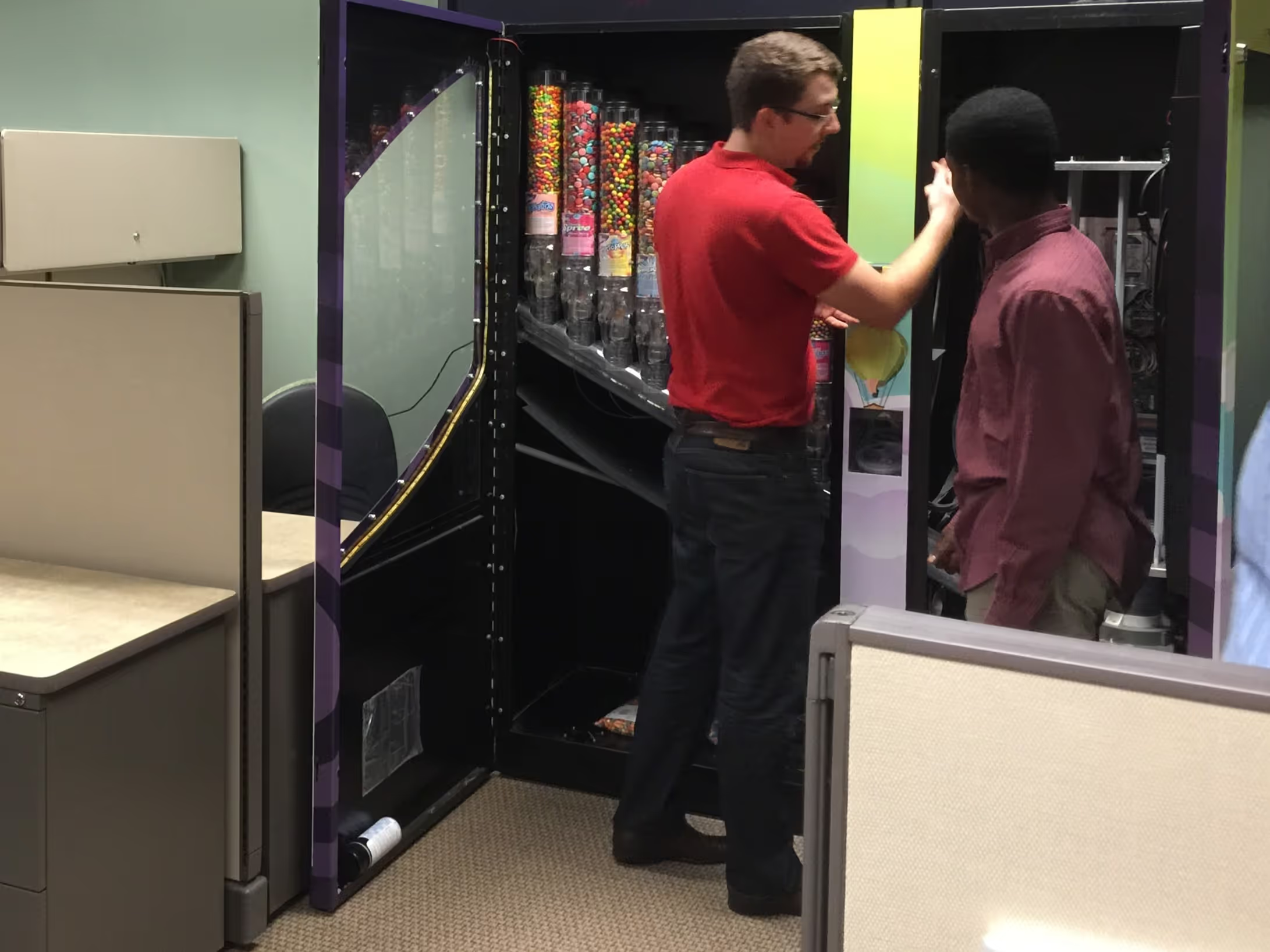
When I first started with Banyan, I was doing Tier 3 support again. I was supporting a customer in Australia, then I ended up supporting a customer in Mexico on these DVD rental machines. So the journey started out doing a lot of what I had done three years prior at NCR.
But the company's natural needs quickly began to evolve. We started to hire other people, we needed to get more thoughtful about technology purchases, we decided to move into our first location, and there were a lot of needs around setting up the network infrastructure, desks and things where it was just more general support of the business, not just support of the customers. That allowed me to use some of my experience in IT support and just general technology, but also to learn a lot about what it takes to establish new processes, establish new tools, make decisions around what hardware we're going to purchase, and what technology we're going to leverage to support our customers.
That evolution naturally flowed into supporting the infrastructure as we started building out Banyan Hills. The first couple of years with Banyan Hills were very professional services-heavy. We were doing mobile app development, custom app development, supporting websites, and building sites, and all along the way, there were technological needs to fulfil those projects. Whether those were in-house needs as we hired contractors or the outsourced teams that we had, or if there were needs to support the customer directly, like, who are we going to use for our hosting provider? What assets and hardware do we need to purchase to test mobile apps? All of that was a natural evolution of not just supporting the customer on these professional services projects, but also supporting the internal team that was doing the development and doing the support.
As we started building the Canopy software and we began getting customers for the Canopy product, there were infrastructure needs. Early on, Benji John and I were the primary people who handled all infrastructure support in AWS, and eventually in Azure. That was a learning challenge as well: figuring out how to structure things and how to do cloud-hosted versus on-prem. There was a lot of learning there, and then that function changed further. We got to a point where it made sense for Benji to be the primary on infrastructure and for me to be the primary on Canopy support and the Canopy customers. So then my role shifted into being both the primary support agent for anything in-house and also for Canopy. Then we started building out a Canopy support team, and I was responsible for managing that team, leading and training those individuals.
Fast forward, and my position has become an active role in the decisions around the product itself, shaping what Canopy is going to look like and what functionalities we're going to continue to build for our customers. It’s also evolved into leading deployment operations as well as the support of the product and the account management of the product.
What's one skill or strength you've developed here that you didn't have when you started?
That's tricky because I've developed many skills and strengths that I didn't have when I started. I joined Canopy at about a five-year point in my corporate career, and it’s been ten years since then. When I started, I had a strong foundation of technical support, infrastructure support, IT management, server management, and a good understanding of supporting devices at scale. Since then, I've gained significant product understanding while also learning how to guide and consult customers to develop solutions for them rather than just supporting a tool I was hired to help.
Early on, I was very good at general support but maybe not at solutioning for customers whereas now my skills in understanding the customer's need and how that aligns with our product have grown tremendously. My management skills may still need some work, but I've had many opportunities to develop my strengths in managing people, teams, and engineering and development. Those are significant areas in which I had no prior experience before joining Canopy.
What's been your most rewarding project during your time at Canopy?
It's hard to pick one project in particular as the most rewarding. Each customer brings its own set of challenges and successes. I'm proud of the projects I've led to add new feature functionality to the product itself, and I focus on delivering functionality that customers can use without relying on the support team, making the product more configurable and giving customers more power. That, as an overarching general sense of product development, has been rewarding.
I would say there's a handful of customers (I won't name names) that came to us when they were really struggling to scale because their tooling and processes were breaking down. For them to be successful as a business, they had to find a tool, and I think really they had to find a team and partner who could help them get to the next level of scale and not hinder the growth that they were seeing. It's been really exciting to see our customers be successful and to grow and to understand that Canopy had a part of that journey. I’ve enjoyed seeing how our team has been a good partner to customers, helping them overcome challenges or to take risks that maybe they would not have taken.
To look at new technologies or new operating systems they wouldn't have if they didn't have a technology partner and a platform like Canopy that could support them in taking those risks or trying out new things. So that's been really rewarding.
Can you share a favorite memory that stands out from the past 10 years?
It's hard again to pick just one favorite memory or turning point. It sounds odd to say, but COVID and the years 2020 and 2021 stand out. Although they were probably the most challenging times that the company has ever faced, the silver lining that came out of that was an intentional and significant shift away from being a professional services company, Banyan Hills, with a product called Canopy to being a product company called Canopy, a company that also offered professional services in support of that product.
Before COVID, we generated most of our revenue from professional services contracts that were not directly related to the Canopy product. They enabled us to build the Canopy product and to fund that development. Back then Canopy, as much as we wanted it to be the primary focus, still wasn't the primary focus for decision-making, resource prioritization, and time allocation. The pandemic saw many of our professional services contracts go away or change and evolve, and it made sense for us to embrace Canopy as our primary focus as a product company.
That is probably the most significant turning point that stands out. At that point, the way we prioritized decisions, our choices, and the customers we were supporting essentially became a focus on reusability. We would streamline what the product could do and sharpen the focus. Instead of having the product try to solve every single problem, we really started to establish an opinion of what the product was and the functionality that it needed to provide to the industries and to our customers.
So, in my mind, that was the most significant turning point, and I see it as a positive shift, but it was also the most challenging thing we'd done prior to that.

Do you live on the edge of endpoint management?
Discover how global brands and businesses manage their connected product ecosystems. Get the inside-scoop from the hidden architects and teams who ensure their remote devices never go down.
Subscribe to the Canopy Insights newsletter.
Do you live on the edge of endpoint management?
Discover how global brands and businesses manage their connected product ecosystems. Get the inside-scoop from the hidden architects and teams who ensure their remote devices never go down.
Subscribe to the Canopy Insights newsletter.
You’ve known for a long time that if you made it to 10 years you’d get a trip to Hawaii. Did you ever imagine hitting that mark? What was the most fun part of your trip?
It's funny to even think about that because I remember we defined the “Banyan Journey” pretty early on, probably within the first year of me joining the team. We laid out a plan for what happened at year one, year three, year five, year seven, and year 10, and 10 was as far as we went. It seemed like a lifetime away. But as the years ticked by, the reality of that milestone became more real.
Before COVID and the shift to becoming a product company, I don't know if I would have thought I'd make it to 10 years. If we had remained a professional services company with a product on the side and Canopy had never shifted to be the primary focus, I don't think I would have made it to 10 years.
But the Canopy product did become the primary focus nearly five years into my career at Canopy, so I was able to spend the next five years really focusing on and building out the product, seeing customers use it and gain benefit from it. So, hitting 10 years with the company became much more achievable at that point.
Being able to go on that trip to Hawaii was really exciting. I'd never been to Hawaii before, so it was a new experience. It was fun to go and see the banyan trees in person. I've never seen banyan trees before, so that was pretty cool, and I just really enjoyed some time away. The trip itself was the longest time I've taken off from the company, and the most consecutive time I've taken off in 10 years. So it was a nice pause and a reflection point on the accomplishment of 10 years, and doing so in a wonderful and enjoyable place was a lot of fun.
What's a challenge you faced during your time at Canopy that taught you the most?
The biggest challenge I faced at Canopy was accepting that people and customers will come and go, even if that is not what you want. You will have employees who have made significant impacts on the product, the culture, and the business as a whole. They will have things come up in their personal life, or they will have other professional opportunities, or their desire for how they want to spend their time or what they want to focus on will change, and they will leave the business.
That's often seen as a negative, and in some cases, it is. I think there are times when people leave that you have to stop, reflect, and learn — what do we need to change about the way we do business, the way we operate as a company, and our culture, in order to prevent further attrition?
However, it's a good learning opportunity and a challenge in how you react in those situations. Take the opportunity to learn and evaluate what the outcome of an individual or customer leaving means for the business, and how you will be productive about it. That has been a recurring lesson and an opportunity to evaluate further decisions and learn what needs to be changed. It's never easy when someone chooses to leave the company for personal or professional reasons, or when a company decides to stop using the product. Still, there's always an opportunity to learn from it and react in a way that's productive and can help shape the experience for remaining customers, future customers, and future employees. So, although it's a tough challenge, there is a lot of opportunity in those situations.
📺 Below, a webinar Nathan hosted with Canopy customer ButterflyMX.
What about Canopy and the team behind it inspires you?
I take great pride in the work I do for Canopy and the customers who use and license it. I'm in a position to drive positive change and continue shaping the product and the company as we grow. There are many individuals in the company who I continue to learn from and enjoy working with, and now that a handful of us have worked together for 10+ years, the interactions with those individuals, the rapport that we have, and the camaraderie that we have continue to grow, and it feels like we are very much on this journey together.
The core founding members who are still with the company, through all of the challenges and changes we've had, are a big part of what has kept me here. And then, second, would definitely be our customers and my desire to continue to see them be successful, and my overarching desire to see the product grow and reach a point where it is a very established, recognized and respected name across the different industries in which we operate.
We've already seen a lot of success, but we haven't reached a point I know we can achieve. Which is keeping me here to help grow the company into what I know it's capable of, and to continue to adapt and find other ways to help companies grow and be successful by utilizing our product and working, specifically with our team. Our team is a big part of what makes Canopy so successful because the individuals supporting the product really understand operating technology and device management at scale. And they also have a genuine personal desire and ambition to help others.
The product wouldn't be successful without the team that we have supporting our customers and really wanting our customers to be successful, not just for our own success and our own financial gain, but for our customers' success.
Congratulations, Nathan, for more than a decade of service. Thank you for all the work you've done and continue to do for Canopy.