Why McDonald’s Leads in Fast Food Tech
McDonald’s leads in restaurant technology by making every system from mobile app to fryer work together. Here’s how cloud and edge computing power its connected restaurant success.

You might not notice technology at quick-service restaurants ([[QSR]]) when it’s working.
But when that tech is acting up, broken down, or a pain to deal with … all you do is notice.
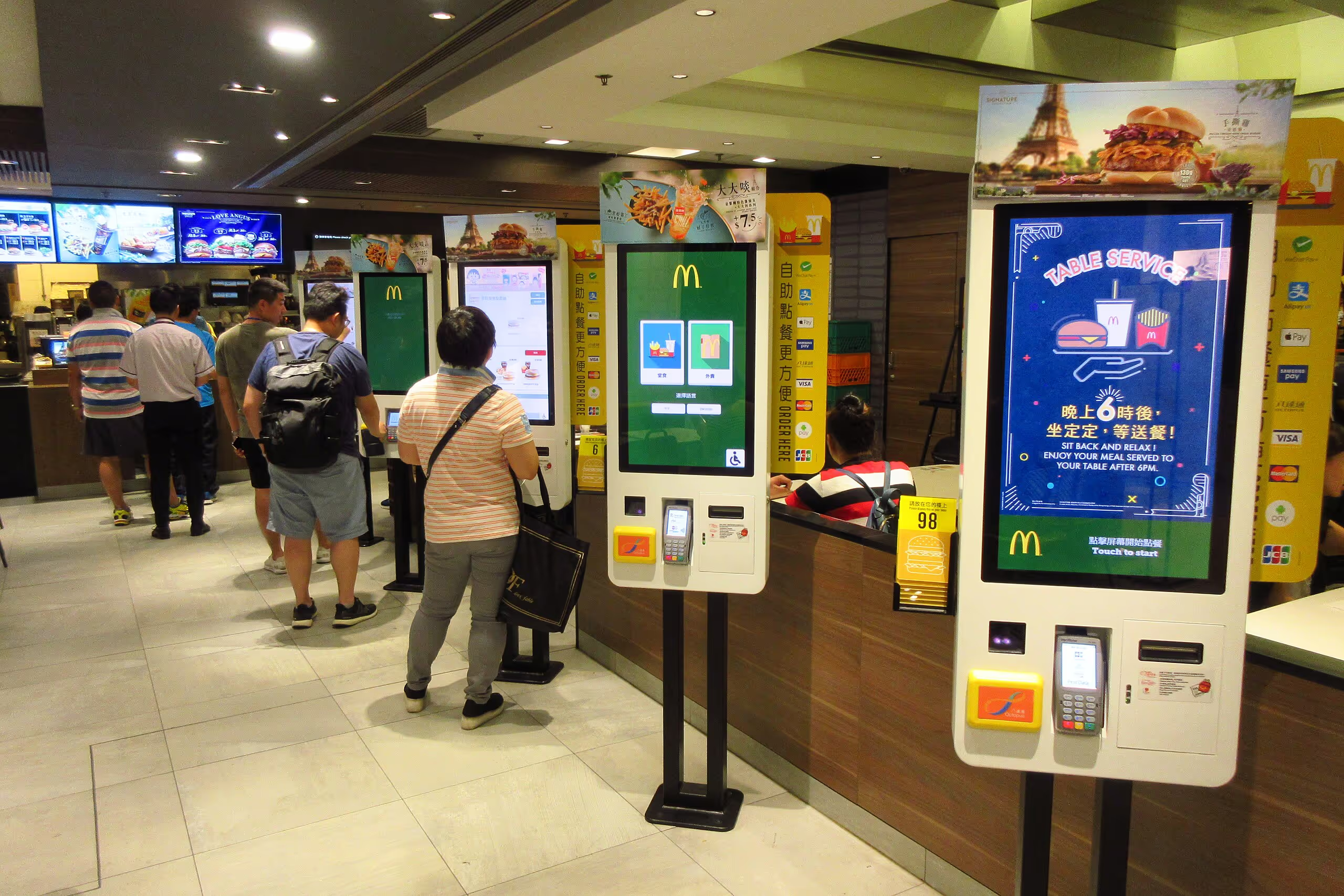
For example, imagine you’re ordering at a self-service kiosk and your app says you have a reward ready. However, for some unknown reason the reward won’t show up on-screen. It’s confusing. Now you feel incompetent. Then the customer behind starts getting impatient.
You could explain your problem to a frazzled cashier if you could find them without abandoning the kiosk. Then again, they’re busy and not looking for more to do.
How's this customer going to think about the experience when it's done?
Moments like these shape customers’ opinions about go-to spots for a quick bite, as well as places to avoid. In our recent Fast-Food Friction survey, a clear winner for restaurant technology emerged:
Customers ranked McDonald’s the number one brand for fast-food technology experience.
.png)
McDonald’s earned the top spot by getting its technology ecosystem to work as one. Their connected restaurant tech stack includes a mobile app, self-service kiosks, drive-thru, all kitchen systems, and a loyalty program. Each of these components and many more are all connected and integrated. The combination means McDonald’s delivers fast, consistent, personalized service at scale.
The challenge with [[connected products]] is they require every system to work in sync. Should one device malfunction or a data handoff break, the customer experience likely breaks with it. Keeping everything running smoothly takes constant oversight and the right tech foundation.
That’s how McDonald’s has gotten to where it is today.
Below, we’ll share how the company brought its connected restaurant to life and what restaurants can learn about how to “serve up” an experience that keeps customers coming back.
Get Fast Food Fault Lines
Access the 2026 Restaurant Tech Report instantly, and find out how to run a more reliable restaurant.
Get Fast Food Fault Lines
Access the 2026 Restaurant Tech Report instantly, and find out how to run a more reliable restaurant.
How the Cloud Makes the Connected Restaurant Work Together
Back in 2014 (when a Big Mac meal cost less than $5 and mobile ordering still felt futuristic), McDonald’s was one of the first fast-food brands to move its core systems to the cloud. At the time, most restaurants were still running on isolated, on-premise systems that were siloed from each other. Useful data from one device that could inform operations on another device was stuck. Also, software updates were slow to deploy, and customers interacted with technology that was inconsistent from one location to the next.
Customer service issues were common for McDonald’s then too. Kitchen staff struggled to manage customizations, and inaccurate orders happened all too often. The company needed a more technically sophisticated way to operate.
Centralizing the management of their restaurant tech operations led them to migrate what they could to the Internet, the “cloud.” They could unify mobile apps, self-service kiosks, and loyalty programs across thousands of restaurants.
This migration laid the groundwork for a [[connected restaurant]]. The idea was intuitive: Every digital and physical system would work together, and customers would get a seamless experience whether they were using the app or rolling through the drive-thru.
As digital orders and customer data grew, McDonald’s expanded this strategy to multiple cloud service providers. The multi-cloud approach provided access to a wider variety of tools that could deliver personalized recommendations and offers, like suggesting a McFlurry on a hot afternoon to a customer with a documented sweet tooth. Within a few years, digital channels drove more than 40% of sales in the company’s top six markets. Global loyalty sales topped $20 billion.
These wins were signs that the company’s connected restaurant strategy was working. If a customer added their go-to order in the app, the kiosk remembered it too. If a promo got pushed out to loyalty members, the POS system was ready to apply the discount, and the prep queue was stocked for an influx of orders. All of this added up to a seamless customer experience.
Edge Keeps It Working in Real Time
To build on its cloud success, McDonald’s brought [[edge computing]] to its U.S. restaurants through a partnership with Google Cloud. The goal was to give each store more real-time control, so it could react to what was happening inside the restaurant, even without a perfect cloud connection.
McDonald’s operators needed to spot problems and make quick decisions during peak service hours because in a high-volume restaurant, things like an overheating fryer or a lagging prep line can snowball fast. McDonald’s wanted its restaurants to catch and address those problems before customers noticed.
Edge computing is used to collect and analyze sensor data on kitchen equipment on site and in real time. If a machine stutters, the system flags it right away. If a crew member starts falling behind during a rush, edge-based tools can adjust prep timing or reroute orders to keep things moving.
Edge computing and cloud systems can work together to deliver the experience customers expect: mobile orders are ready when they arrive, kiosks reflect their loyalty points in real time, drive-thru orders stay accurate and on pace, and there are fewer frustrating delays caused by broken equipment or slowdowns.
As a restaurant becomes more connected, it also becomes more complex. Each new piece of equipment or digital tool adds a point of potential failure. Teams need visibility into how each device is performing and where friction might show up next. Success looks like proactive resolutions and automatic troubleshooting, which translate to customers having a friction-free experience that’s consistent for each visit to a given restaurant and across McDonald’s franchises.
The Behind-the-Scenes Reality According to McDonald’s Franchise Insiders
McFranchisee, a popular McDonald’s franchise operator on the Twitter/X platform, recently shared that, “McD is running infrastructure some startups only dream of. These Google Edge Cloud rack [sic] are just one tiny slice of our stack. I’d be shocked if any competitor on Earth runs more tech than McDonalds.”
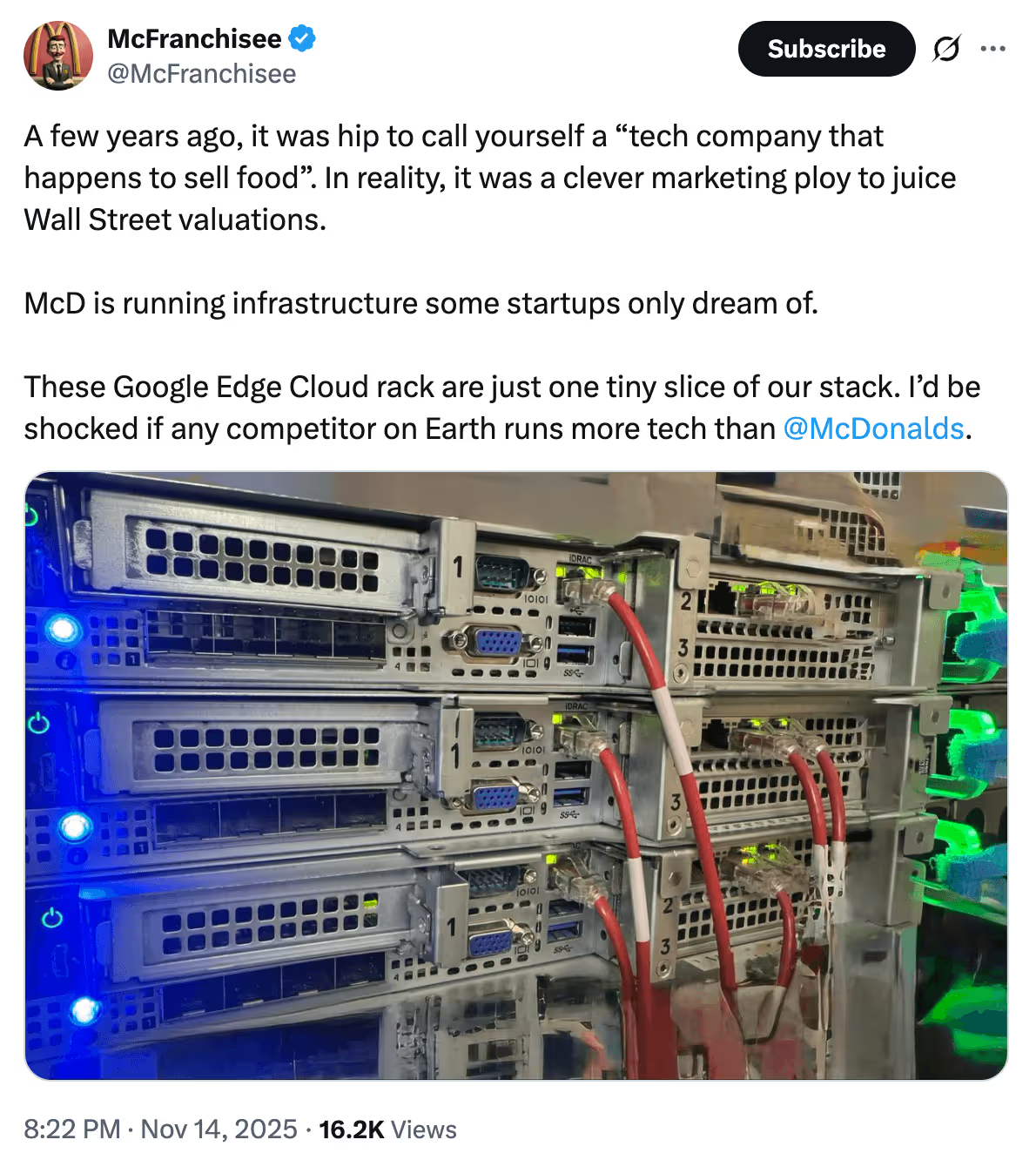
McDonald’s Google Edge Cloud racks support the restaurant’s register system and kitchen video system. So, for example, when an employee enters an order into the register, the technology pushes the order to different monitors in the kitchen in a useful way to the staff who must prepare the food, “... the order will pop up that you need to put a quarter pounder on the grill, another screen may show that you need to drop a Bun, another screen may be to produce an iced coffee, etc.”
McFranchisee’s claim of McDonald’s restaurant tech dominance is supported by the 2025 Restaurant Tech report: McDonald’s is a leader in restaurant technology, but his callout here sparked a useful discussion around how well McDonald’s restaurant technology works. Turns out the deployment of infrastructure hasn't been without challenges. One user, zooch24, reported an early experience with the Google Edge Cloud rack, stating: “Wait till it goes down. We rolled out one of the first stores. Was supposed to be redundant so the store wouldn't go down. Little did we know. 5 hours later and all sorts of people involved it finally came back up. Edge still is gonna need a lot of work.”
McDonald’s does offer support to franchisees in the form of training: Operators are able to certify their own technicians through McDonald’s classes to install and manage the systems. Even so, the practice of technical support for a McDonald’s is ongoing and more complicated than simple technology installation, and even simple issues can still slip through the cracks. Take the case of mobile ordering: one customer couldn't order from their local McDonald's late at night because "the app thinks Dinner hours end at 10:59 PM, even though the store is open until 1 AM." The fix is internal yet hasn’t been communicated correctly, according to. "That's an internal store setting the operator needs to adjust. You should tell the GM to fix their mobile schedule in RFM. I bet they have no clue."
McFranchisee also points out how certified techs may still require on the job training, “BUT - there are some things [franchisees] aren’t allowed to do and [certified technicians] charge us an outrageous amount to complete the task. Oftentimes tech’s coming to do the install don’t have the experience yet we pay them to do the task we coach them to do.”
The tech is expensive, with McFranchisee sharing how much fees have grown over the last several years: “Tech fees make me cry on a monthly basis - something that was extremely minimal 15 years ago.” Another operator agreed, “Seems like the monthly tech costs go up quite a bit with Edge; more of a subscription model. But hardware costs go away on this equipment? My store just moved to edge last week.”
The big question is whether these restaurant tech investments will pay off. McFranchisee sees benefits in and the hope of franchisees like McFranchisee is that tech like the Google Edge Cloud rack will enable “Future AI/automation capabilities + hosts a variety of servers we use for register system, app orders, delivery, etc.”
Time will tell.
What Quick-Service Restaurants Can Do Today
McDonald’s approaches technology holistically, meaning every feature is backed by the infrastructure it needs to work reliably and fit into a larger system. That mindset is what allows them to deliver consistent, low-friction experiences across tens of thousands of restaurants.
Here’s what that looks like in practice:
- Technology and software are designed to work in sync. A promo added to the loyalty program has to show up in the app, reflect on the kiosk, and route correctly through the POS and kitchen queue.
- Backend, technical infrastructure comes first. Before launching new features, McDonald’s made sure its core systems could support them at scale — for example, during peak hours.
- Reliability builds trust. Customers come back when things work the way they expect. That means spotting issues early, fixing problems quickly, and keeping the system running without surprise failures.
- More restaurant tech means more to manage. With every added screen, sensor, and service channel, the system gets more complex. Restaurants need the ability to monitor performance across every remote device and software integration, acting fast should things slip out of sync.
McDonald’s is a leader in the QSR space for many reasons. One of them is certainly their leadership in developing a best-in-class connected restaurant experience. And with 80% of consumers saying technology influences which restaruant they visit, leadership pays off (see also: Chick-fil-A).
Customers notice a good experience. Better, they can't notice a bad one. To learn more about how customers see QSR tech, get the full report.
Article originally published August 20, 2025. Updated November 20, 2025.


.avif)
.jpg)